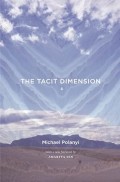
The tacit dimension
“I shall reconsider human knowledge by starting from the fact that we can know more than we can tell,” writes Michael Polanyi, whose work paved the way for the likes of Thomas Kuhn and Karl Pop…
- Edition
- -
- ISBN/ISSN
- 978-0-226-67298-4
- Collation
- xix,108p.; 21 cm.
- Series Title
- -
- Call Number
- 121 POL t

An enquiry concerning human understanding, c.1-2
About a year before his death, the author remarked to his publisher: "as to any suitable returns or approbation from the public, for the care, accuracy, labor, disinterestedness, and courage of my …
- Edition
- -
- ISBN/ISSN
- 0-87220-230-5
- Collation
- xvii,142p.; 22 cm.
- Series Title
- -
- Call Number
- 121 HUM a.1-2

Kant's 'Critique of Aesthetic Judgement': A Reader's Guide
Kant's Critique of Judgment is one of the most important works in the history of philosophy. It is a classic text, in which Kant elucidates his aesthetic theory, and is an important piece of philos…
- Edition
- -
- ISBN/ISSN
- 978-0826497680
- Collation
- viii,196p.
- Series Title
- -
- Call Number
- 121 HUG k

The philosophy of science
The more than fourty readings in this anthology cover the most important developments of the past six decades, charting the rise and decline of logical positivism and the gradual emergence of a new…
- Edition
- -
- ISBN/ISSN
- 0-262-02315-6
- Collation
- xvii,800p.; 24 cm.
- Series Title
- -
- Call Number
- 121 BOY p

Evidence and inquiry: towards reconstruction in epistemology
In this important new work, Haack develops an original theory of empirical evidence or justification, and argues its appropriateness to the goals of inquiry. In so doing, Haack provides detailed cr…
- Edition
- -
- ISBN/ISSN
- 0-631-19679-X
- Collation
- x, 259p.; 23 cm.
- Series Title
- -
- Call Number
- 121 HAA e

Personal knowledge: towards a post-critical philosophy...
This book Builds off of insights of Heidegger and Merleau-Ponty, and connects them with his knowledge as a chemist. Original synthesis by an original thinker who is passionate for the truth. One of…
- Edition
- -
- ISBN/ISSN
- -
- Collation
- xvi, 428p.; 20 cm.
- Series Title
- -
- Call Number
- 121 POL p

Belief and unbelief: a philosophy of self-knowledge
Atheism is a cruel and long range affair, Jean-Paul Sartre writes in The Words. He thinks he has carried it through. This book opens a new and vital dialogue between the believer and the atheist; t…
- Edition
- -
- ISBN/ISSN
- -
- Collation
- 223p.; 22 cm.
- Series Title
- -
- Call Number
- 121 NOV b
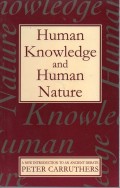
Human knowledge and human nature
Contemporary debates in epistemology devote much attention to the nature of knowledge, but neglect the question of its sources. This book focuses on the latter, especially on the question of innate…
- Edition
- -
- ISBN/ISSN
- 0-19-875102-8
- Collation
- 1991
- Series Title
- -
- Call Number
- 121 CAR h

How do we know: an introduction to epistemology
Epistemology, the study of knowledge, can often seem like a daunting subject. And yet few topics are more basic to human life. We are inquisitive creatures by anture, and the unending quest for tru…
- Edition
- -
- ISBN/ISSN
- 978-0-8308-4036
- Collation
- 175p.; 23 cm.
- Series Title
- -
- Call Number
- 121 DEW h




 Computer science, information & general works
 Philosophy & psychology
 Religion
 Social sciences
 Language
 Pure Science
 Applied sciences
 Arts & recreation
 Literature
 History & geography