
Piety & politics: evangelicals and fundamentalists confront..
"Forget nuclear freezers and yuppies. The emergence of the evangelical vpting bloc is the most important political development ofthe 1980s, and Neuhaus and Cromatie tell everthing you need to know …
- Edition
- -
- ISBN/ISSN
- 0-89633-107-5
- Collation
- ix, 424p.; 23 cm.
- Series Title
- -
- Call Number
- 277.308 NEU p

The future of John Wesley's theology: back to the future..
This book approaches the future of John Wesley's theology in terms of a preferred future by looking back to the Apostle Paul. In a comparison of Wesley's theology with the writings of St. Paul, Tex…
- Edition
- -
- ISBN/ISSN
- 978-1-61097-629-9
- Collation
- xvi, 120p.; 23 cm.
- Series Title
- -
- Call Number
- 230.709 WES f
A guide to the book of Exodus
Following the series pattern, detailed interpretation and commentary on the Bible narrative are supported by special notes on the historical and literary background, and on the importance of Exodus…
- Edition
- -
- ISBN/ISSN
- 0-281-02952-0
- Collation
- xiii,201p.; 22 cm.
- Series Title
- -
- Call Number
- 222.12 DOB g

The roundtable pulpit: where leadership & preaching meet
Most preachers use a sovereign leader-centered style or an inductive (consultative) style of preaching. John McClure shows why these styles are sometimes manipulative and ineffective: they do not t…
- Edition
- -
- ISBN/ISSN
- 0-687-01142-6
- Collation
- 127p.; 21 cm.
- Series Title
- -
- Call Number
- 262.1

Postliberal theology and the church Catholic
Wright's conclusion draws from the substance of the interviews to offer some stimulating because traditional tools for both re-describing the methodological underpinnings of deep ecumenical coopera…
- Edition
- -
- ISBN/ISSN
- 978-0-8010-3982-9
- Collation
- xi,159p.; 22 cm.
- Series Title
- -
- Call Number
- 230.092 WRI p

God has many names
What was the message? He thinks their needs to be a “Copernican” revolution of sorts, where instead of religions revolving around their particular revelation, be it Jesus, Mohammad, Buddha, etc…
- Edition
- -
- ISBN/ISSN
- 0-664-24419-X
- Collation
- 140p.; 21 cm.
- Series Title
- -
- Call Number
- 261.2 HIC g

Justification by faith alone: affirming the doctrine.., c.1-2
Church history since the Reformation reveals wave after wave of attacks against the biblical doctrine of justification by faith alone. The indisputable fact is that in eras when this doctrine has b…
- Edition
- -
- ISBN/ISSN
- 1-57358-155-0
- Collation
- xii, 163p.; 22 cm.
- Series Title
- -
- Call Number
- 234.2 MAC j.1-2
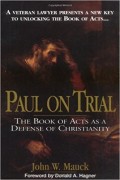
Paul on trial the books of Acts..
JOHN W. MAUCK provides an exciting new way of understanding the Book of Acts. With great skill and powerful arguments, the author contends that Acts was written primarily to defend Paul for his for…
- Edition
- -
- ISBN/ISSN
- 0-7852-4598-7
- Collation
- xviii,236p.; 23 cm.
- Series Title
- -
- Call Number
- 226.6 MAU p

Luke's portrait of Paul, c.1-2
Luke's hero is Paul. But is the hero of Acts the historical Paul? As the author of this interesting and provocative study makes clear, there are several problems with the biographical details of Pa…
- Edition
- -
- ISBN/ISSN
- 0-521-60945-3
- Collation
- xiv,192p.; 22 cm.
- Series Title
- -
- Call Number
- 226.6 LEN l.1-2

How relevant is the Bible: and other commentaries on Scripture
In many of his books, John L. McKenzie has confined himself to the exposition of one theme. Here is a chance to encounter his thinking on a wide variety of biblical topics--a first-rate sampling of…
- Edition
- -
- ISBN/ISSN
- 978-1-60608-047-4
- Collation
- 216p.; 22 cm.
- Series Title
- -
- Call Number
- 220.071 MCK h


 Computer science, information & general works
 Philosophy & psychology
 Religion
 Social sciences
 Language
 Pure Science
 Applied sciences
 Arts & recreation
 Literature
 History & geography