Christianity among the New Zealanders
It is only hundred and fifty years since New Zealand, first sighted in 1642 by the Dutch sailor Abel Tasman, was annexed by the British Government by the Treaty of Waitangi in February 1840. But al…
- Edition
- -
- ISBN/ISSN
- 0-85151-566-5
- Collation
- 384p.; 20 cm.
- Series Title
- -
- Call Number
- 261.994 WIL c

Symbolism in religion and art
All of the author's previous writings have attempted to reveal the universal rational foundation that undergirds all of the various ethical, political and economic systems that best nurture human e…
- Edition
- -
- ISBN/ISSN
- 978-0-7618-3875-3
- Collation
- vi, 94p.; 23 cm.
- Series Title
- -
- Call Number
- 246.17 TAY s
Facing grief: counsel for mourners
In 1674, two years after his second wife's death, the author published a token for mourners. In it he meditates on the words of Luke 7: 13. From this verse the author helps the reader to think abou…
- Edition
- -
- ISBN/ISSN
- 978-1-84871-069-6
- Collation
- xiv,122p.; 18 cm.
- Series Title
- -
- Call Number
- 261.8 FLA f

Sex these days: essays on theology, sexuality and society
What has been lost, what been gained in replacing sexual orthodoxy with the 'heresies' of postmodern sexualities? In the recent past-even within living memory-sex has usually been a matter of monog…
- Edition
- -
- ISBN/ISSN
- 1-85075-804-2
- Collation
- 223p.; 23 cm.
- Series Title
- -
- Call Number
- 261.832 DAV s

The next reformation: why evangelicals must embrace..
In The Next Reformation, Carl Raschke describes the impact of postmodernism on evangelical thought and argues that the two ideologies are not mutually exclusive. Instead, Christians must learn to w…
- Edition
- -
- ISBN/ISSN
- 0-8010-2751-9
- Collation
- 235p.; 23 cm.
- Series Title
- -
- Call Number
- 261.51 RAS n

Christ and culture in dialogue: constructive themes..
Since Niebuhr in his classic "Christ & Culture" used Luther as a prime example of one of his five typologies of how a Christian responds to culture, this book provides the necessary correction of L…
- Edition
- -
- ISBN/ISSN
- 0-570-04273-9
- Collation
- 332p.; 23 cm.
- Series Title
- -
- Call Number
- 261 MEN c

Christ in India: essays towards a Hindu-Christian dialogue
This is a gentle, beautifully written book that should be read by anyone who senses the importance of religious understanding for the future well-being of humanity. It contains many delightful pass…
- Edition
- -
- ISBN/ISSN
- 0-87243-134-7
- Collation
- 249p.; 21 cm.
- Series Title
- -
- Call Number
- 261.245 GRI c
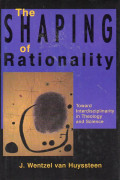
The shaping of rationality: toward interdisciplinarity in theology.., c.1-2
This book arises out of a deep fascination with the relationship between human intelligence abd rationality, and with how our fragile but uniquely human ability to be rational invariably affects ou…
- Edition
- -
- ISBN/ISSN
- 0-8028-3868-5
- Collation
- ix,303p.; 24 cm.
- Series Title
- -
- Call Number
- 261.55 HUY s.1-2
A doctor's casebook; in the light of the Bible
- Edition
- -
- ISBN/ISSN
- -
- Collation
- 256p.; 22 cm.
- Series Title
- -
- Call Number
- 261.55 TOU d
- Edition
- -
- ISBN/ISSN
- -
- Collation
- 256p.; 22 cm.
- Series Title
- -
- Call Number
- 261.55 TOU d

The science of God
This book is a clear, concise guide to Alister McGrath's groundbreaking three-volume work A scientific theology. McGrath himself here summarizes his major project and sketches out its implications …
- Edition
- -
- ISBN/ISSN
- 0-8028-2815-9
- Collation
- xiv,271p.; 18 cm.
- Series Title
- -
- Call Number
- 261.55 MCG s


 Computer science, information & general works
 Philosophy & psychology
 Religion
 Social sciences
 Language
 Pure Science
 Applied sciences
 Arts & recreation
 Literature
 History & geography