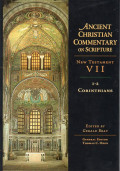
Ancient Christian commentary on scripture New Testament, v.7: 1-2 Corinthians…
In Paul's letters to the Corinthian church, the pastoral issues of a first-century Christian community stand out in bold relief. And as the apostle responds to these challenges, the fathers lean ov…
- Edition
- -
- ISBN/ISSN
- 0-8303-2492-8
- Collation
- xxiii,349p.; 27 cm.
- Series Title
- -
- Call Number
- R 225 SIM a/7.1-3

Ancient Christian commentary on scripture New Testament, v.2: Mark, c.1-2
The early church valued the Gospel of Mark for its preservation of the apostolic voice and gospel narrative of Peter. Yet the early church fathers very rarely produced sustained commentary on Mark.…
- Edition
- -
- ISBN/ISSN
- 0-8303-1418-3
- Collation
- xxxv,284p.; 27 cm.
- Series Title
- -
- Call Number
- R 225 SIM a/2.1-2

Ancient Christian commentary on scripture New Testament, v.8: Galatians..,Phi…
he doctrines of Christ, of salvation, and of the church all owe their profiles to these letters. And for patristic interpreters, who read Scripture as a single book and were charged with an insatia…
- Edition
- -
- ISBN/ISSN
- 0-8303-2493-6
- Collation
- xxv,318p.; 27 cm.
- Series Title
- -
- Call Number
- R 225 SIM a/8.1-2

Ancient Christian commentary on scripture New Testament, v.10: Hebrews, c.1-2
Distinctive in form, content, and style, the epistle to the Hebrews offers a profound high Christology and makes an awe-inspiring contribution to our understanding of Jesus as our High Priest. The …
- Edition
- -
- ISBN/ISSN
- 0-8303-1495-4
- Collation
- xxvi,292p.; 27 cm.
- Series Title
- -
- Call Number
- R 225 SIM a/10.1-2

Ancient Christian commentary on scripture New Testament, v.5: Acts, c.1-2
The Acts of the Apostles--or more in keeping with the author's intent, the Acts of the Ascended Lord--is part two of Luke's story of "all that Jesus began to do and teach." In it he recounts the ex…
- Edition
- -
- ISBN/ISSN
- 0-8303-14890-6
- Collation
- xxvi,368p.; 27 cm.
- Series Title
- -
- Call Number
- R 225 SMI a/5.1-2

Ancient Christian commentary on scripture New Testament, 1A: Matthew 1-13, c.1-2
The Gospel of Matthew stands out as a favorite biblical text among patristic commentators. The patristic commentary tradition on Matthew begins with Origen's pioneering twenty-five-volume commentar…
- Edition
- -
- ISBN/ISSN
- 0-8303-1486-8
- Collation
- 326p.; 27 cm.
- Series Title
- -
- Call Number
- R 225 SIM a/1A.1-2

Ancient Christian commentary on scripture New Testament, v.4B: John 11-21, c…
The Gospel of John was beloved by the early church, much as it is today, for its spiritual insight and clear declaration of Jesus' divinity. Clement of Alexandria indeed declared it the "spiritual …
- Edition
- -
- ISBN/ISSN
- 0-8303-1099-4
- Collation
- 462p.; 27 cm.
- Series Title
- -
- Call Number
- R 225 SIM a/4B.1-2

Ancient Christian commentary on scripture New Testament, v.3: Luke, c.1-2
For the church fathers the Gospels did not serve as resources for individual analysis and academic study. They were read and heard and interpreted within the worshiping community. They served as so…
- Edition
- -
- ISBN/ISSN
- 0-8303-1488-6
- Collation
- xxvii,444p.; 27 cm.
- Series Title
- -
- Call Number
- R 225 SIM a/3.1-2

Ancient Christian commentary on scripture New Testament, v.11: James, 1-2 Pet…
No book of the Old Testament is more frequently quoted in the New than Isaiah, and no portion of Isaiah is more frequently quoted in the New than the typologically fertile soil of Isaiah 40-66. Sti…
- Edition
- -
- ISBN/ISSN
- 0-8303-1496-5
- Collation
- xxx,288p.; 27 cm.
- Series Title
- -
- Call Number
- R 225 SIM a/11.1-3
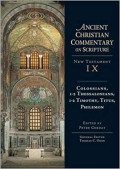
Ancient Christian commentary on scripture New Testament, v.9: Colossians.., c…
While patristic commentary on St. Paul's shorter letters--Colossians, 1-2 Thessalonians, the Pastorals and Philemon--was not so extensive as that on his longer letters, certain passages in these le…
- Edition
- -
- ISBN/ISSN
- 0-8303-1486-8
- Collation
- xxx,288p.; 27 cm.
- Series Title
- -
- Call Number
- R 225 SIM a/9.1-2


 Computer science, information & general works
 Philosophy & psychology
 Religion
 Social sciences
 Language
 Pure Science
 Applied sciences
 Arts & recreation
 Literature
 History & geography